
Shopify AI and No-Code: What It Means for Store Owners and Developers
Building a Shopify store once required a mix of design decisions, development work, and ongoing manual effort to keep things running smoothly. While the platform has always been more accessible than traditional development, it still relied on a certain level of technical involvement, especially as stores grew in complexity. That dynamic is starting to change.
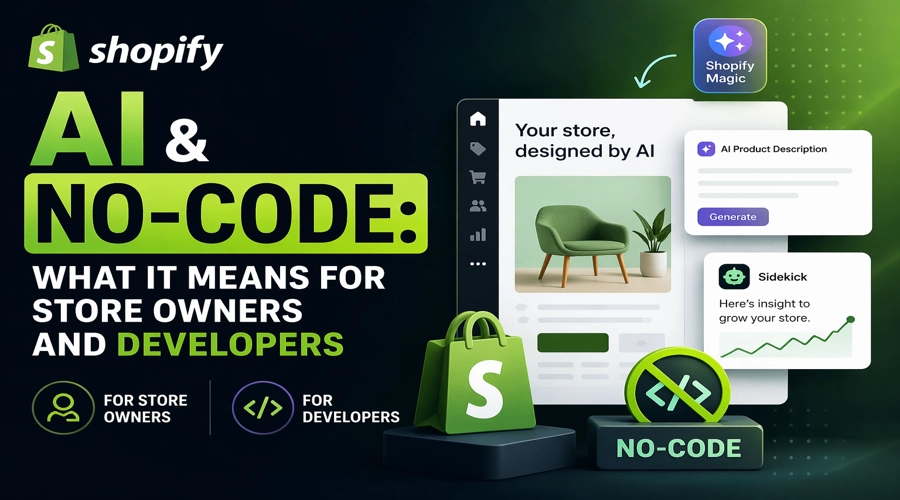
With the introduction of AI-powered features like Shopify Magic and Shopify Sidekick, Shopify is gradually reducing the amount of effort required to build, manage, and optimize an online store. Tasks that once required separate tools, teams, or technical input can now be handled more quickly and, in some cases, automatically.
This shift is raising an important question: Is Shopify becoming a no-code platform?
The answer isn’t as straightforward as a yes or no. Shopify is not fully no-code yet. But it is moving in that direction, step by step, by introducing AI across different parts of the workflow. From store setup and content creation to decision-making and automation, these changes are not happening all at once. Instead, Shopify is evolving toward a no-code ecosystem in layers.
And as this evolution continues, it’s not just changing how stores are built; it’s also reshaping the role of developers who build them.
In this blog, we’ll break down how Shopify is moving toward no-code, the role AI is playing in that transition, and what it means for both store owners and developers going forward.
Is Shopify Really No-Code? Here’s What It Means
The term “no-code” is often used broadly, but in practice, it can mean different things depending on the platform and use case.
In its context, no-code Shopify doesn’t mean the complete absence of code. Instead, it refers to the ability to build, manage, and operate an online store without needing to write or understand code for most day-to-day tasks.
This includes things like:
- Setting up a store using pre-built themes
- Customizing layouts through visual editors
- Installing and configuring apps without development work
- Managing products, orders, and content through a structured interface
At its core, Shopify has always leaned toward a low-code model, where basic functionality is accessible without coding, but more advanced requirements still need developer involvement.
What’s changing now is how far that accessibility is being extended. With the introduction of artificial intelligence, Shopify AI is beginning to show up in different ways and is trying to move beyond traditional no-code capabilities. It’s not just simplifying actions; it’s starting to assist with decisions, automate processes, and reduce the need for manual input across different stages of store management.
This creates a shift from
- No-code Shopify (doing without coding) to
- AI-assisted No-code Shopify (doing with minimal effort and guidance)
Understanding this distinction is important, because it sets the foundation for how Shopify is evolving, not as a fully no-code platform overnight, but as a system that is gradually reducing the need for code through layered improvements.
In the next section, we’ll look at the role AI is playing in this shift and how tools like Shopify Magic and Sidekick are contributing to this evolution.
The Role of Shopify AI in the No-Code Evolution
Shopify AI’s move toward no-code isn’t happening through a single feature or update. It’s being driven by the gradual introduction of AI across different parts of the platform.
Tools like Shopify Magic and Shopify Sidekick are not standalone innovations; they are part of a broader shift toward reducing the effort required to build and run an online store.
What makes this shift important is not just what these tools do individually but also what they remove from the process.
Shopify Magic: Removing the Need to Create Manually
Shopify Magic focuses on one of the most time-consuming parts of running a store, content creation.
It offers everything from product descriptions and email campaigns to basic store copy; it allows users to generate content quickly without starting from scratch. What previously required writing, editing, and iteration can now be initiated with simple inputs and refined in minutes. This has a direct impact on how stores are built and managed.
Instead of:
- writing every product description manually
- drafting marketing emails from scratch
- spending time structuring basic store content
Users can now generate a working version almost instantly. The result isn’t just faster execution; it’s a reduction in dependency on manual effort.
Shopify Magic isn’t only about removing development work, but it’s about reducing friction across the entire workflow, and it does exactly that for content.
Shopify Sidekick: Reducing the Need to Figure Things Out
While Shopify Magic focuses on execution, Shopify Sidekick moves a step further; it assists with decision-making.
Sidekick acts as an AI assistant that helps users understand their store, interpret data, and identify what actions to take next. Instead of navigating dashboards or analyzing metrics manually, users can:
- ask questions about store performance
- get simplified insights
- receive suggestions on what to improve
This changes how users interact with the platform. They’re no longer just using tools; they’re being guided through them, and that’s where the shift becomes more significant. Because as AI starts to:
- explain what’s happening
- suggest what to do
- guide users through actions
…it reduces the need for both technical knowledge and experience.
The Real Shift: From Doing Things Manually to Being Assisted by AI
Individually, Shopify Magic and Sidekick solve different problems.
But together, they point to a larger trend.
- Magic reduces the effort to create
- Sidekick reduces the effort to decide
And when both of these are combined, the overall process becomes significantly more accessible. This doesn’t make Shopify fully no-code. But it does move it closer to a system where:
- less manual work is required
- fewer decisions are made without guidance
- and more of the process is assisted or automated
Which is exactly how no-code Shopify will evolve: not all at once, but step by step, layer by layer.
Shopify’s No-Code Evolution in Layers
Shopify isn’t becoming a no-code platform through a single feature or update. Instead, it’s gradually reducing the need for coding by introducing changes across different parts of the workflow.
These changes don’t replace development entirely, but they do reduce how much of it is needed for most use cases. The easiest way to understand this shift is to look at it in layers.
Layer 1: No-Code Store Setup
At its foundation, Shopify has already made it possible to build a functional store without writing code. Users can:
- choose and customize themes
- structure pages using sections
- install apps for additional features
This layer removes the need for basic development work. For many small businesses and early-stage stores, this is enough to get started without technical support. But while setup is simplified, the effort doesn’t stop there.
Layer 2: No-Code Content Creation
Once a store is set up, the next challenge is content: product descriptions, emails, and overall messaging. This is where Shopify Magic comes in. Instead of creating everything manually, users can:
- generate product descriptions
- write marketing emails
- build store content faster
This layer removes one of the most time-consuming parts of running a store. It doesn’t just save time; it reduces the need for specialized skills like copywriting.
Layer 3: No-Code Decision Support
Running a store isn’t just about building it; it’s about knowing what to do next. This is where Shopify Sidekick changes the experience. Instead of manually analyzing dashboards and reports, users can:
- ask questions about performance
- get simplified insights
- receive recommendations
This layer reduces the need for experience and interpretation. Users are no longer just managing their store; they’re being guided through it.
Layer 4: No-Code Operations & Automation
Beyond setup and decision-making, there’s the day-to-day work of running a store. This includes:
- order processing
- inventory updates
- customer workflows
- marketing triggers
Through built-in features and integrations, Shopify enables much of this to be automated without coding. This layer removes repetitive manual effort and makes operations more efficient.
Layer 5: Toward Autonomous No-code Shopify (What’s Emerging)
The final layer is still evolving, but it’s where things are heading. As AI becomes more integrated, Shopify is moving toward systems that can:
- suggest improvements automatically
- optimize store performance
- handle tasks with minimal input
This doesn’t mean fully autonomous stores yet. But it does point toward a future where:
- less intervention is required
- more processes are handled intelligently
- and stores become increasingly self-managed
Limitations: Is Shopify Fully No-Code Yet?
Despite these advancements, Shopify is not a fully no-code platform. While AI tools like Shopify Magic and Shopify Sidekick reduce effort across many areas, there are still clear limitations.
- Advanced customization still requires coding, especially for unique designs or features
- Complex integrations (third-party tools, APIs) often need developer support
- Scalability and performance optimization go beyond what no-code tools can handle alone
- Over-reliance on apps can create limitations in flexibility and control
In short, Shopify is moving toward no-code, but it hasn’t eliminated the need for development.
For simple stores, no-code Shopify works well. For more complex or high-growth businesses, developer involvement is still essential.
What This Means for Shopify Developers
As Shopify continues to evolve with AI and no-code capabilities, the overall effort required to build and manage a store is clearly being reduced. Tasks that once needed hands-on development or manual input are becoming more streamlined, and in some cases, automated. This makes it easier for non-technical users to get started and manage basic operations without relying heavily on developers.
At the same time, expectations from e-commerce stores are increasing. Businesses are no longer just looking for functional websites; they want better performance, deeper integrations, and more tailored user experiences. This shifts the role of developers away from basic execution toward more complex, high-value work that goes beyond what no-code tools can handle.
Are Shopify developers still needed? The answer is yes; but not in the same way as before.
How is the Nature of Work Is Changing
As Shopify becomes more accessible through AI and no-code features, the type of work developers are expected to do is beginning to shift.
With tools like Shopify Magic assisting with content and Shopify Sidekick helping guide decisions, the overall process of building and managing a store is becoming more streamlined.
This doesn’t remove developers from the equation, but it does change where their time is spent. Instead of focusing on initial setup, repetitive implementation and basic customization, developers are gradually being pulled away from these lower-complexity tasks.
These areas are becoming faster, more accessible, and, in some cases, manageable without technical expertise. As a result, the value of purely execution-based work is starting to decline, not because it’s unimportant, but because it’s no longer as difficult or time-consuming as it used to be.
What’s emerging in its place is a greater demand for work that goes beyond setup, work that involves deeper understanding, problem-solving, and long-term thinking. And that’s where the role of developers begins to shift more clearly in the next stage.
Where Developers Still Add Real Value
While entry-level tasks are being simplified, the more complex side of Shopify AI development remains firmly dependent on expertise. This includes:
- building custom features and functionalities
- handling complex integrations and data flows
- optimizing for performance and scalability
- creating tailored user experiences beyond templates
These are not areas that AI or no-code tools can fully handle today.
The Shift Toward Higher-Value Roles
What’s happening is not a reduction in demand but a shift in expectations. Developers are moving from executing predefined tasks to solving more complex, business-driven problems
This includes:
- understanding how different systems connect
- designing scalable architectures
- working alongside AI tools rather than competing with them
Adapting to the Shift
To stay relevant in this evolving landscape, developers need to adjust how they work. This means:
- using AI tools to speed up workflows
- focusing less on repetitive tasks and more on customization
- building skills around integrations, automation, and performance
- thinking beyond code, toward overall system design
The Bigger Picture
Shopify AI is making it easier to build and run stores, but that doesn’t eliminate the need for expertise. It changes where that expertise is applied.
Developers are no longer just building storefronts; they are shaping how those stores function, scale, and perform in a more complex ecosystem.
The shift toward no-code and AI is not replacing developers; it’s redefining their role. Those who adapt will find themselves working on more meaningful, higher-impact problems. Those who don’t may find their work increasingly handled by the very tools reshaping the platform.
Concluding Thoughts
The idea of Shopify becoming a fully no-code platform is compelling, but it doesn’t tell the complete story. What’s actually happening is a more gradual and layered shift. Through tools like Shopify Magic and Shopify Sidekick, along with improvements in themes, automation, and integrations, Shopify AI is steadily reducing the effort required to build and manage an online store.
At the same time, it’s not eliminating complexity; it’s redistributing it. For store owners, this means faster setup, easier management, and a lower barrier to entry. More of the process is accessible without technical knowledge, making it easier to move from idea to execution in a shorter time frame.
For developers, the impact is different. The role is not disappearing, but it is shifting away from basic implementation and toward more advanced, high-impact work. Areas like customization, performance optimization, integrations, and system-level thinking are becoming more important, as they go beyond what no-code tools and AI can handle on their own.
Shopify isn’t becoming no-code overnight. It’s becoming no-code in layers, with each improvement reducing friction across the workflow. As this continues, the most effective approach won’t be choosing between AI and development but understanding how the two work together.
Because while AI can accelerate the process, it still takes structured thinking and technical expertise to build something that performs well, scales effectively, and delivers long-term value. That balance is where the real advantage lies and where the future of Shopify development is headed.
People Also Ask
1. Can AI fully replace Shopify development?
No, AI cannot fully replace Shopify development. While AI tools can automate tasks like content creation, basic store setup, and insights, advanced customization, integrations, and performance optimization still require developer expertise.
2. How does AI help in Shopify store development?
AI helps in Shopify development by automating content creation, suggesting store improvements, and simplifying decision-making. Tools like Shopify Magic and Shopify Sidekick reduce manual effort, making it faster and easier to build and manage a store.
3. What is Shopify Magic and how does it work?
Shopify Magic is Shopify’s AI tool that generates product descriptions, emails, and store content based on user input. It works by using AI to create ready-to-use content, helping store owners save time and effort.
4. What does Shopify Sidekick do for store owners?
Shopify Sidekick is an AI assistant that helps store owners understand performance, answer questions, and suggest improvements. It simplifies data analysis and guides users on what actions to take next.
5. Will AI replace Shopify developers?
AI will not replace Shopify developers, but it will change their role. Developers will focus more on advanced tasks like custom features, integrations, and performance optimization, while AI handles repetitive work.
6. Is coding required for Shopify?
Coding is not required for basic Shopify stores. Users can create and manage stores using themes, apps, and built-in tools. However, coding is needed for advanced customization and complex functionality.
7. Is Shopify no-code?
Shopify is not fully no-code. It offers many no-code features for setup and management, but complex requirements still require development. It is best described as a low-code platform moving toward no-code with AI.

Co-Founder & CMO at eWebWorld
Rahul Chandrawanshi is the Co-Founder and Chief Marketing Officer at eWebWorld, where he contributes to business strategy, digital growth, and client success. He brings a business-focused perspective to case studies, highlighting the challenges businesses face, the solutions implemented, and the outcomes achieved through digital experiences and technology.
Search
Popular Posts





Follow us

Recent Posts



About eWebWorld
eWebWorld is a Shopify and eCommerce development company in India with 10+ years of experience building and scaling online stores. We specialize in Shopify development, including store setup, customizations, theme development, migrations, integrations, and performance optimization. Through our expertise in eCommerce, technology, and digital marketing, we help businesses create better online experiences and achieve sustainable growth.